Valuation Headwinds for US Equities
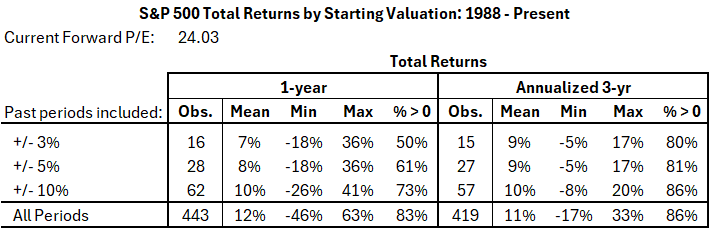
Our forward P/E for the S&P 500 Total Return Index is currently 24.03, higher than 89% of periods since 1984. These valuation levels have historically translated into light-to-moderate (but not particularly strong) headwinds for US stock returns.

Historical periods with starting valuations similar to today include some months in 1997, 2001, 2017-18, and 2020-21. Analysis of total returns from these “best-match” periods shows the following:
- The index rose an average of 7-10% over the subsequent year and an annualized average of 8-10% over three years. For comparison, since 1988 the index’s average total return over those time horizons has been 12% and 11%/year respectively.
- The index fell over the next year in 50-75% of periods and was still lower after three years in 14-20% of periods.
- None of the best-match periods saw exceptional returns (30%/yr or more) that the index has achieved with lower starting valuations. The top 3-yr return was 20%/yr, however, still well on the high end.
- On the low side, one close comparable returned -5% per year over three years. Another with a slightly higher starting valuation saw 3-yr returns of -8% annualized.
Note: Many values are given in ranges, since exact figures depend on how closely we match our current forward P/E to past values. The following table presents results for periods with starting values within 3%, 5%, and 10% of today, alongside average returns for all periods for comparison.
DIsclaimer
This report presents historical facts and does not constitute investment advice. None of the information should be interpreted as a recommendation to buy, hold, or sell any investment security.
As the saying goes, past performance is not a determinant of future returns. The next 1-3 years may or may not fall within historical ranges. Differences in index asset composition, monetary policy, inflation, and numerous other factors will all play a role in corporate results that drive index dividend returns and investor decisions that drive price returns.
 Windfactor Investment Research